Hi again UpTrust! I'm Sara Ness, Resident Research Nerd (aka Research Director) at the social health nonprofit SeekHealing, CEO of Authentic Revolution, and co-founder of the OG Austin Authentic Relating and Circling communities.
This is an article I published on my Substack which I think might be suitable for ROAR. Not sure if privately published articles are fair game, but if they are and a non-original-research one is allowable, this felt fun to submit.
Abstract:
The article explores why people avoid deep conversations with strangers, despite evidence suggesting those conversations go better than expected.
The core of the piece draws on research by Kardas, Kumar, and Epley, which found that people consistently underestimate how interested strangers are in their authentic revelations. Across multiple settings, participants expected deep conversations to feel awkward — but afterward reported feeling more connected and happier than anticipated.
The article includes an interview with a real-life vulnerability guru (the author's mother) who asks strangers deeply personal questions and consistently turns those encounters into genuine connections.
-----------
SCIENCE SAYS: HAVE DEEPER CONNECTIONS
My mom has a knack for making friends. A knack that, even as a 33-year-old, makes me put my hand over my eyes and groan, “Mooooooom!”
No matter where she is, she turns to strangers and asks them some inappropriately deep question. Then she tells them something inappropriately deep about herself. And then…before I’m done squirming in embarrassment…
…they’re friends?
My mom knows people all over the world. Multiple times, she has ended up on a plane to Thailand or Uzbekistan or Vietnam (traveling just for fun), gotten into a conversation, and ended up staying at that person’s house a few days later. People just fall in love with her, this tiny woman with a giant spirit and no social filters.
She upends all the rules. And somehow, it works.
There are two mysteries in this equation.
One, why do we believe that instigating deep conversation with strangers is not going to go over well, when Mom uses those techniques to make more friends than any one person can keep?
Two, why, even though I have been a communications teacher for 13 years specifically focusing on authenticity and vulnerability, do I get the squirmies about that degree of openness?
In other words: does social stranger danger exist? And if it doesn’t, why are our brains so convinced it do?
In this article, we’ll:
Explore a wonderful study that tests the perception vs the reality of deep conversation
Have an interview with mom on the upsides, downsides, and genesis of her openness
Open up a pandora’s box of future questions on why, how, and when vulnerability can become more a part of our lives.

Is It Weird and Awkward to Get Real With Strangers?
I have to thank my new friend Floris Van Vugt, who runs the Human Connection Science Lab at the University of Montreal (Yes, wtf, I didn’t know it existed either), as the impetus for this piece. He sent me a wonderful article that documents a series of experiments on vulnerability with strangers. I’ll be quoting this a lot here, so I want to give attribution to the authors Michael Kardas, Amit Kumar, and Nicholas Epley for their research.
To quote the article’s abstract:
We hypothesized that people systematically underestimate how caring and interested distant strangers are in one’s own intimate revelations and that these miscalibrated expectations create a psychological barrier to deeper conversations. As predicted, conversations between strangers felt less awkward, and created more connectedness and happiness, than the participants themselves expected.
Translation: we expect people to be less interested in our vulnerability than they actually are. Thinking they’re not interested stops us from sharing, which keeps us from deeper conversations.
Kardas, Kumar, and Epley ran a series of experiments to test their hypothesis.
Depth Perception vs Depth Reality
Imagine you’re a financial executive at a management conference. You walk into a session, expecting a talk or workshop on a topic you’re familiar with. The room is full of strangers. But that doesn’t matter, because you won’t be interacting, right?
The speaker tells you to open up your computer or phone and scan a link. You read (paraphrased): “You are going to be randomly paired with another attendee here who you do not know. We will ask you to answer or discuss 4 questions:
For what in your life do you feel most grateful? Tell the other participant about it.
If a crystal ball could tell you the truth about yourself, your life, your future, or anything else, what would you want to know?
If you were going to become a close friend with the other participant, please share what would be important for him or her to know.
Can you describe a time you cried in front of another person?”
Prior to making you interact, the page asks you to rate your expectations of the interaction. How interested do you think you’ll be in the other person’s answers? How interested do you think they’ll be in hearing yours? How awkward will this be? How happy will you be that you did it?
Needless to say, this was not the session you expected. You look nervously at the exit. But before you can escape, you’re paired up and given a card with the questions. For 10 minutes, you have a discussion you probably never expected to have at a management conference.
Then, you go back to your seat and report on how it was.
The Results
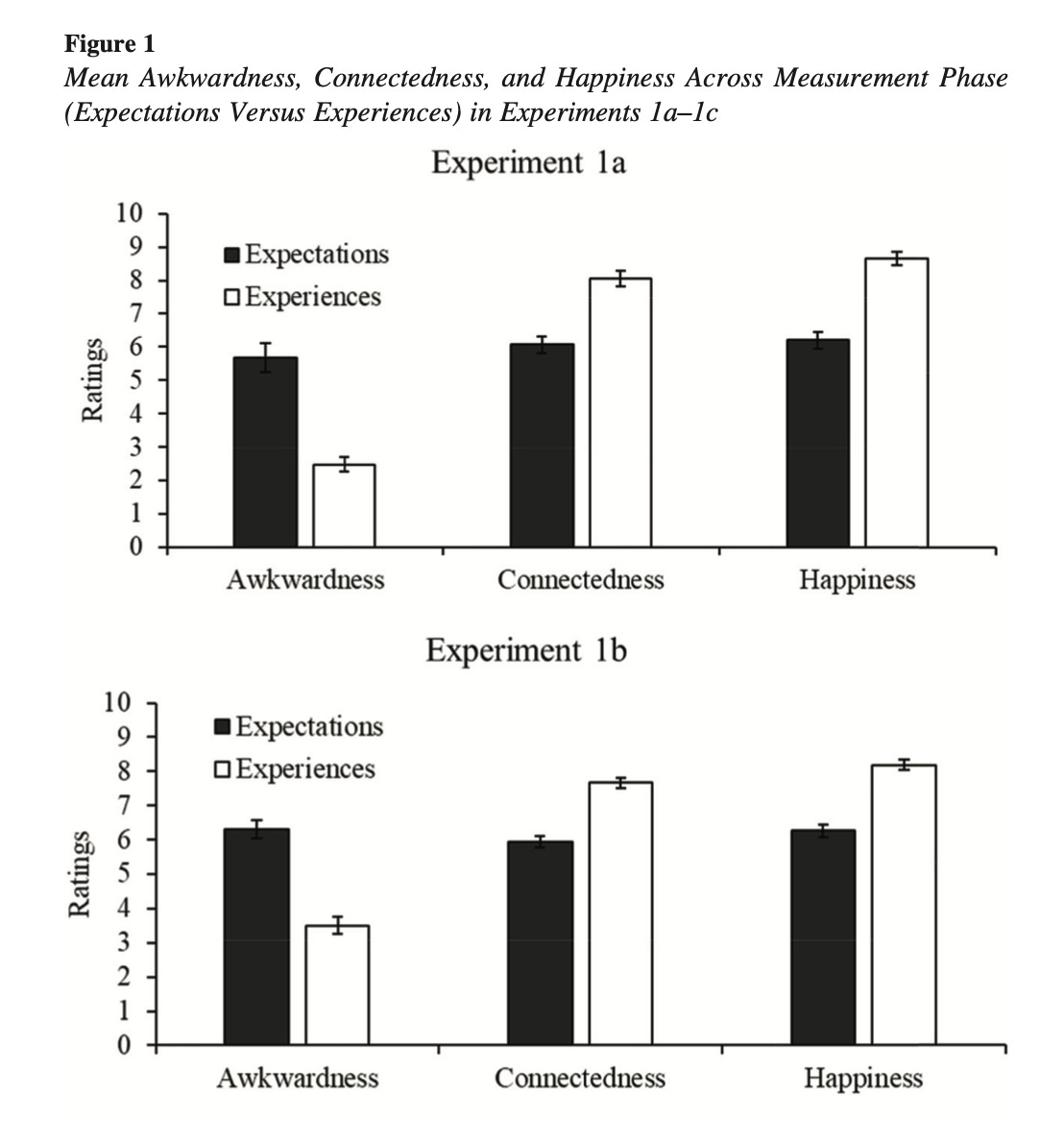
As you can see, there was a large difference between people’s preconceptions of a deep conversation’s awkwardness, and how awkward it actually was. People also found themselves more connected and more happy afterwards than they expected to be.
There was an even larger difference between how much interest respondents thought others would have in their answers, and how interested the listeners actually were. There was even a difference in how much people thought they’d be interested in listening to others, and how interested they were when actually hearing the responses.
In other words, we are pretty off in our perception of how welcome depth will be to strangers. (Well, maybe my readers aren’t 😉 )
But - I hear you say - couldn’t this just be a function of the testing environment? People at a conference are unlikely to expect intimacy, so of course their ratings will be different.
Kardas, Kumar, and Epley ran the same experiment in 3 different circumstances. They tested it on financial conference attendees, managers and employees at a financial services firm, and international MBA students in an online session.* All the tests gave similar results. You can see the 1a vs 1b above, for the first two test groups.
*Admittedly, none of these are groups likely to have high expectations of intimacy. I’d love to see this experiment run in tons of scenarios - on a street corner, at a public library, at a burn.
These results predict each other. When we think others aren’t going to be interested in what we have to say, and/or we won’t be interested in them, we don’t expect to feel connected or happy after the conversation. We expect to feel awkward. If we trust our assessment, we won’t have the interaction - it seems like there’s more potential for harm or boredom than good.
But, it seems that our projections may be off. We may be missing out on a lot of lovely interactions that both people would like to have.
Kardas, Kumar, and Epley ran several more experiments in this line, testing a) expectations of closeness vs awkwardness with shallow vs deep questions, b) whether this varied when the participants came up with their own questions, and c) whether participants’ feelings changed if they were relating to someone they knew vs someone they didn’t.
The findings were generally repetitive of the first experiment, but here are some interesting bits:
Both shallow and deep conversations raise our sense of connectedness and joy. The effect difference between shallow and deep was not as large as I expected it to be (connectedness difference = .14 to 1.74 points on an 11-point scale; happiness difference = .1 to 1.44).
We don’t expect how much happier even shallow conversations will make us. There was a greater difference between how connected people expected to feel in shallow conversations and how much they did feel, as compared to how connected they expected to vs did feel from deep conversations.
We’re more calibrated in our expectations of those we know versus those we don’t. Testing strangers vs friends and family at a park, the researchers found that whether the conversations were deep or shallow, with those they knew, people’s expectations of their feelings of awkwardness or connection were closer to their feelings afterwards. BUT, all the conversations were still less awkward and more connected than they thought!
Our expectation of how much others will care mediates how much we share. When people assumed that their partners would care about their responses (ex. when they were given a character sheet of the person they were about to interact with, saying that person seemed sociable, caring, and considerate), they pre-chose deeper questions to discuss. When they were primed to think that their partner seemed indifferent and uncaring, they pre-chose shallower questions.
TL;DR:
Conversations, whether they’re light or deep, tend to make us happier and (surprise surprise) more connected. Most of the time, they’re less awkward than we think they will be, even when we’re discussing our hopes and dreams with strangers. Other people are generally more interested than we expect them to be - and we’re more interested in them.
So, we now know that interacting with strangers will probably go better and make us happier than we expect it to. Let’s hear from Mom on this point - and then, I’ll tell y’all why these studies raise far more questions for me than they solve.
An Interview with the Vulnerability Guru (aka my mom)
S: Hey Mom. Are there any downsides to your level of openness with strangers?
M: I honestly can’t think of any downsides it has.
S: Are you sure?
M: Well - sometimes it makes people uncomfortable. It feels intrusive. I know that you get uncomfortable when I’m asking people questions, and [your brother] Joel hates it. But your perception of the discomfort is much greater than it is to the recipient.
S: It definitely used to make me uncomfortable. But, since I’ve seen how positively people respond, I’ve gotten less so. I do notice another feature of your openness - while you’re really good at making connections, many of them seem not to last long.
M: I tend to fall in love with people and make friends who aren’t friends, so I get disappointed.
S: Yeah, I sometimes call that “vulnerability one-night stands” - you get to know one side of a person, maybe the best version of themself; but it’s not what comes out all the time. Do people ever misinterpret your openness? When I give focused attention, some people get very drawn in, whether or not I feel the same for them.
M: Yes. I am so intense that my connection with people goes into the bucket of love. It flips some people out and it brings others in.
Where do you think your openness comes from?
M: Hmm…the main influence I can think of is when I was an epidemiologist at the University of Pittsburgh. I had a role model - Lou Kohler - that taught me it was possible to be curious and risk-taking and be admired.
S: In my experience, you’ve always been really open. I remember when I was a little kid, we were trying to cross a street, and a crossing guard was trying to help us. We kept going to opposite corners from him. When we finally met up, you hugged him right in the middle of the street!
M: I come at most interactions with people assuming that we’re going to be buds. We’re going to walk away hugging. I guess not everyone does that.
I call this the “Mom Law” of social physics: “Vulnerability is less dangerous than you think.”
Let’s close this article with a whole bunch of openings to research questions, and potential future articles.
The Mysteries
Why do we limit what we share with others? Epley and co’s hypothesis is that we fear others won’t be interested in our responses, we won’t be interested in theirs, or it will be awkward. My hypothesis is that the fear of downstream effects is a larger factor. “Will others talk about me behind my back? Will my words be used against me? Will people start avoiding me because I seem “heavy”?
Thus, related: in a non-manipulated environment, is intimacy actually safe? This setup was like Authentic Relating - the context was to be intimate, and thus the likelihood of negative response was low. In a more naturalistic and long-term setup, what ARE the immediate and downstream negative effects of “over-sharing” or “over-asking”?
What is the comfort distribution of how much openness people are available for? Aka on a level from weather to trauma, where does someone’s level of comfort and intimacy in hearing about it rise, peak, and fall?
Is that mediated more by personality or by situation?
Situation: do people expect their openness to be recieved more openly at Burning Man than at a management conference?
Personality: Are there some people who are at the same level of openness regardless of situation, and others that change more?
How does openness correlate to conversational depth? There must be a cutoff around the area of trauma dumping. If, as this study shows, openness generally leads to more connection, where does that curve of intimacy peak? Is it a curve at all?
What is the correlation between how much openness the average person is available for, and the amount of openness we actually share?
Here’s to the mysteries that connect us.
Your loving Thought-Dom,
Sara Ness